
BAI: Active Management Of Stocks Across The AI Stack
Jonathan Kitchen/DigitalVision via Getty Images
Introduction To The iShares A.I. Innovation and Tech Active ETF
The iShares A.I. Innovation and Tech Active ETF (BAI) by BlackRock, Inc. (BLK), as part of their iShares’ brand of ETFs, was listed in October 2024. At the time of writing, it has an AUM of $13.53 billion. It follows a semi-annual distribution policy (with an annualized yield of 1.37% at the current ETF price) and has an expense ratio of 0.55%.
What Does BAI Do?
BAI is actively managed and not one of those ETFs that passively tracks a certain index through full replication or representative sampling. BAI’s fund managers (currently two individuals: Tony Kim and Reid Menge) seek to build this portfolio of 43 global stocks through a fundamental, bottoms-up approach, with a focus on businesses, regardless of market cap, that are behind AI innovation. Stocks that are behind the AI innovation make up a broader but interconnected stack encompassing infrastructure, apps & services, and intelligence.
BAI’s fund management team will seek to engage with the C-suite of companies involved in this business, examine third-party reports, and build proprietary models and expected outcomes before assigning individual stakes to potential AI holdings.
AI stack (iShares)
What Are The Main Features Of BAI’s Portfolio?
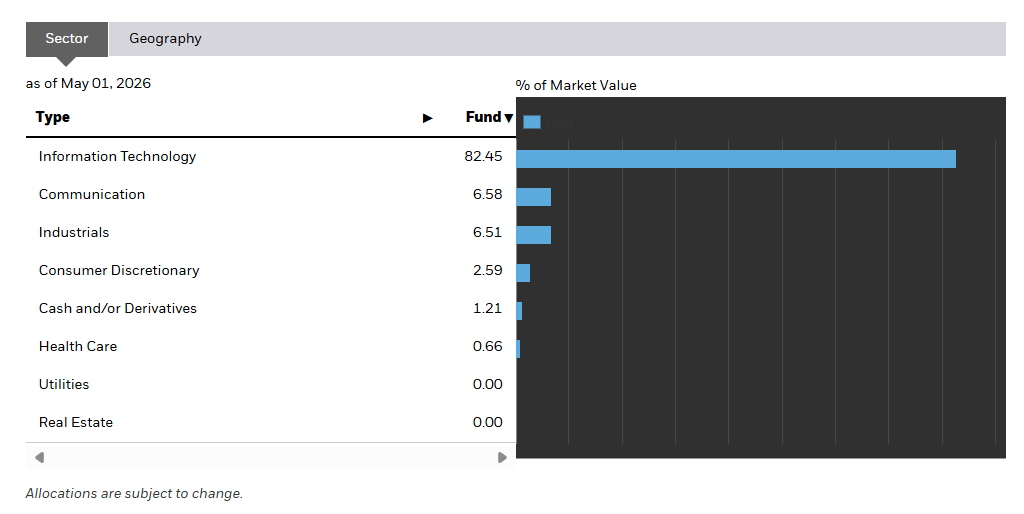
The nomenclature of this product includes the word “tech,” so there should be no surprise to see that the IT sector accounts for an overwhelming chunk (83%) of the portfolio, followed by the communication sector and industrial sector in near-identical proportions (of less than 7% each).
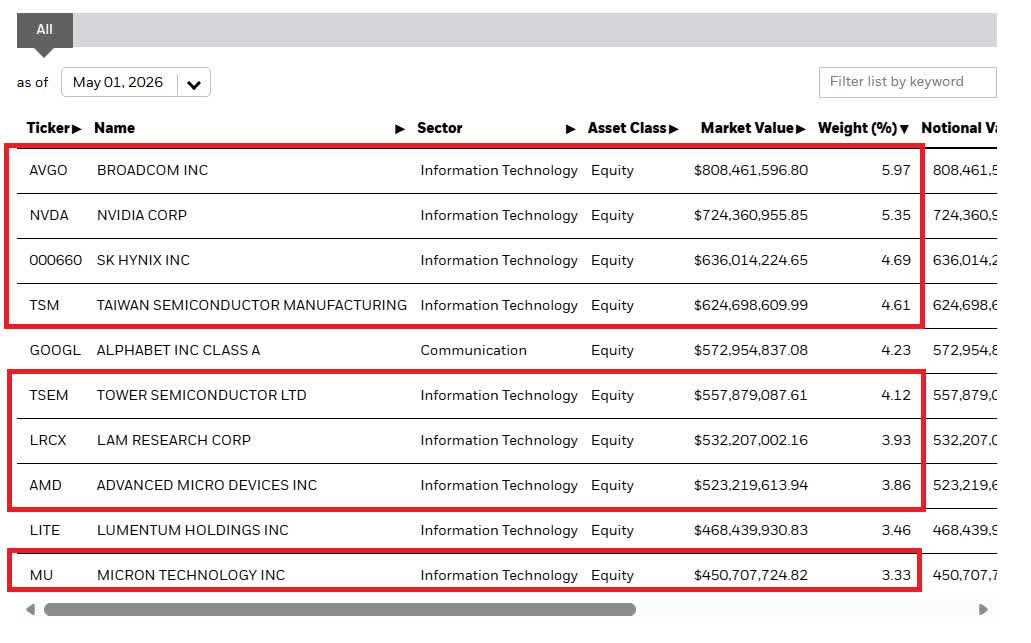
Within the information technology sector, the sub-sector that stands out in BAI is semiconductors, and one can even get a sense of this in the top 10 stocks of the portfolio, where 8 of them are all classified as semiconductors (the ones boxed in red).
BAI also offers coverage to artificial intelligence and tech stocks across different market-cap brackets (including small-caps, which account for less than 7%), although the lion’s share consists of giant-caps that account for 42% of the portfolio.
Market cap (Morningstar)
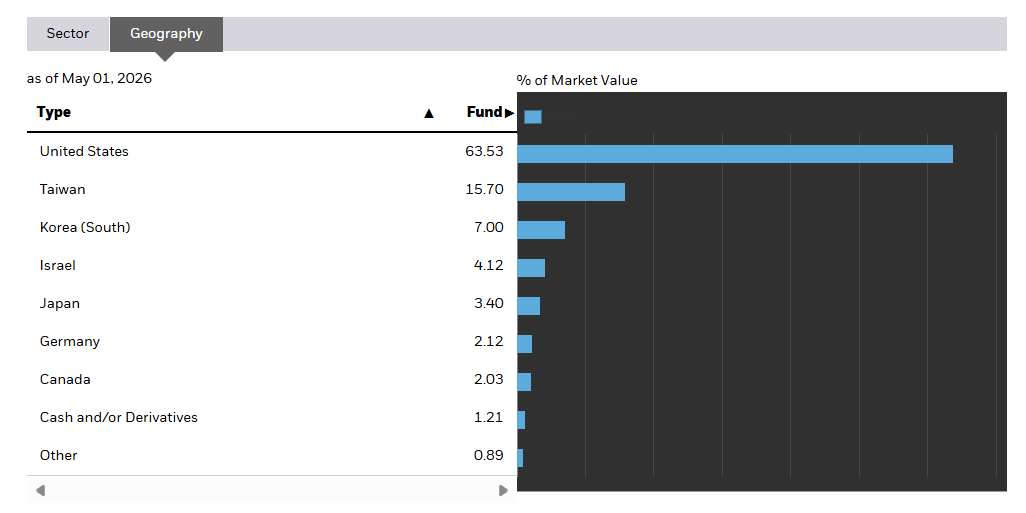
On paper, BAI may be a globally focused product, but it is still very US-centric, with almost two-thirds of the portfolio domiciled here. Of course, this may change over time if the AI tech landscape were to change geographically.
What Are The Risks Associated With BAI?
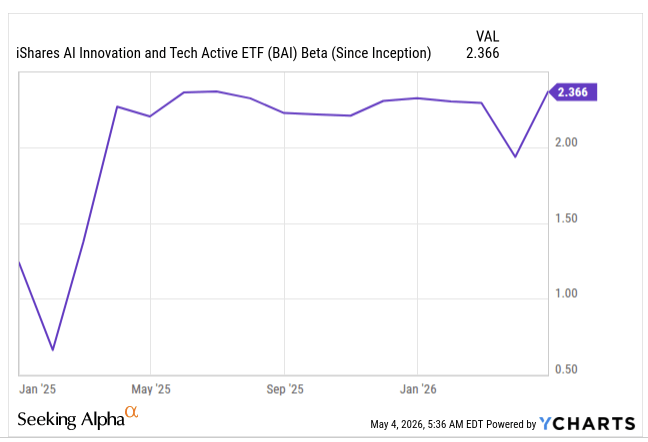
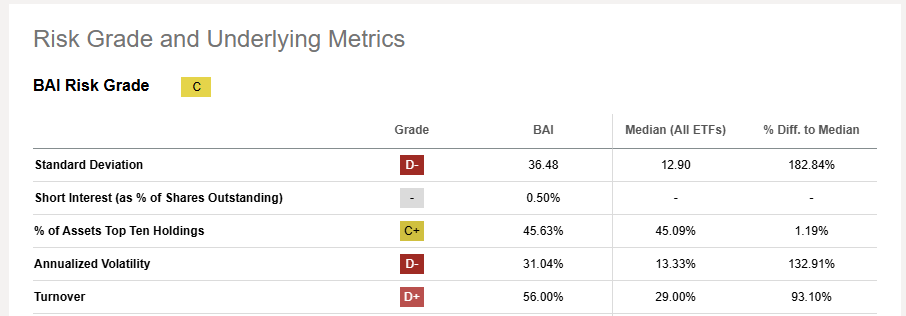
BAI’s beta since it got listed has worked out to almost 2.4x, so for every 2% decline in the S&P 500, BAI could potentially decline by a larger threshold of almost 5%. This also assumes high correlation, which can change over time.
Investors who dislike seeing wild swings in the returns of their portfolio holdings may find a product like BAI unsuitable, as its annualized volatility of over 30% is over 2x more than the volatility profile of a standard ETF (around 13%).
Given that this is an actively managed portfolio, the holdings within BAI are likely to be turned over quite often and may not even be around in a year’s time. For context, while most ETFs experience annual churn of less than 30%, BAI’s annual churn works out to 56%, suggesting over 1 in 2 stocks get turned over every year. Such a high turnover threshold also results in ample transaction costs (during the buying and selling of the position), which end up impacting the overall returns of the ETF.
While BAI’s holdings are largely domiciled in the US, there is still around 33% of the portfolio that comes from abroad; given that BAI’s NAV is denominated in USD terms, but 33% of the portfolio comes from abroad, BAI’s returns could also be impacted to some extent if the USD appreciates against the currencies of its foreign holdings, even if those foreign holdings don’t move either way over a period of time.
Who Is BAI For?
BAI looks like an ideal satellite holding for those who want actively managed coverage of the theme of artificial intelligence within a broader portfolio. One could argue that picking AI-themed stocks requires a certain fundamental skillset and deep domain knowledge, given the rapid degree of change associated with this technology, and BAI’s fund managers are well-placed to pick up on this, given their deep expertise (Tony Kim has been researching the technology sector since 1996 across different organizations, while Reid Menge has been developing his expertise in the tech sector since 1993).
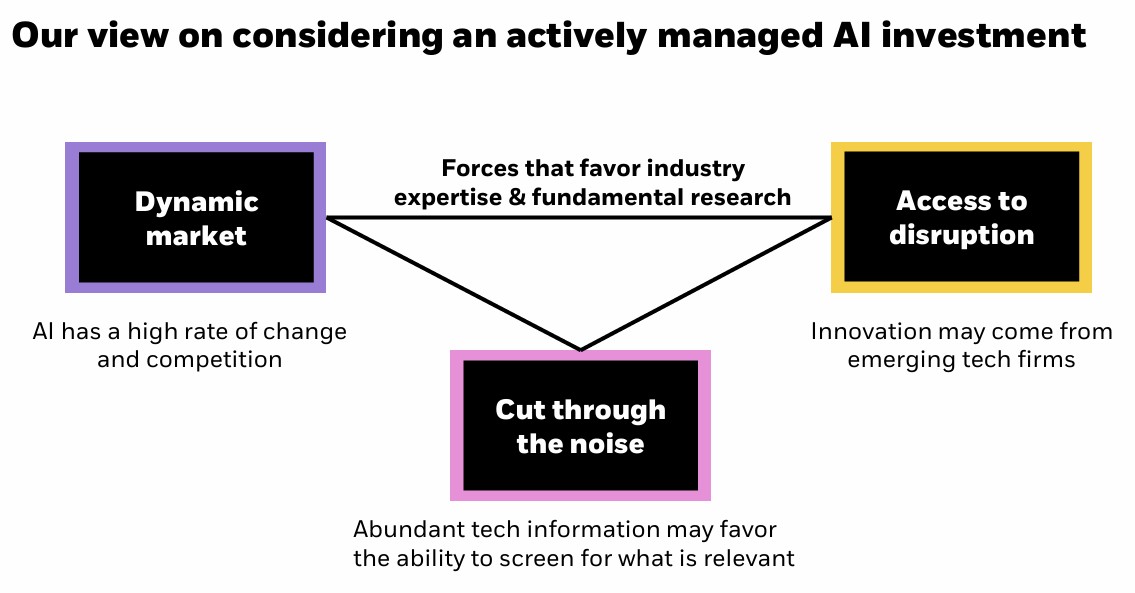
Within artificial intelligence, BAI’s exposure is also not uni-dimensional and limited to certain pockets but is rather well-spread out, serving as a well-diversified ETF proxy for those who don’t want to miss out on the contribution of different stacks of AI (infrastructure, intelligence, apps & services). As AI becomes more mainstream and transformational, different parts of the stack could step up at different stages, and thus an actively managed approach could be seen as more fitting, given the flexibility that these managers have in doubling down or reducing exposure to different stacks.
BAI’s strong exposure to the semiconductor sector also means that investors who get involved with this product won’t just be pursuing businesses that are at the heart of AI’s proliferation but also those that are likely to serve as key agents of a broader technological revolution.
Depending on how BAI is priced relative to markets, BAI could likely also draw GARP-style investors (investors who like businesses that are priced at reasonable valuations but yet offer strong growth potential). After all, BAI is currently priced at 20x earnings (not cheap, but not as pricey as the Nasdaq, which is priced at an earnings multiple of over 25.5x), but its holdings are poised to deliver long-term earnings growth of over 29%. This not only implies a compelling price-to-earnings-growth ratio of less than 1x, but it is also more than double the earnings growth capabilities of the tech-heavy Nasdaq (less than 14%).
Valuation vs earnings (Morningstar)
Peers
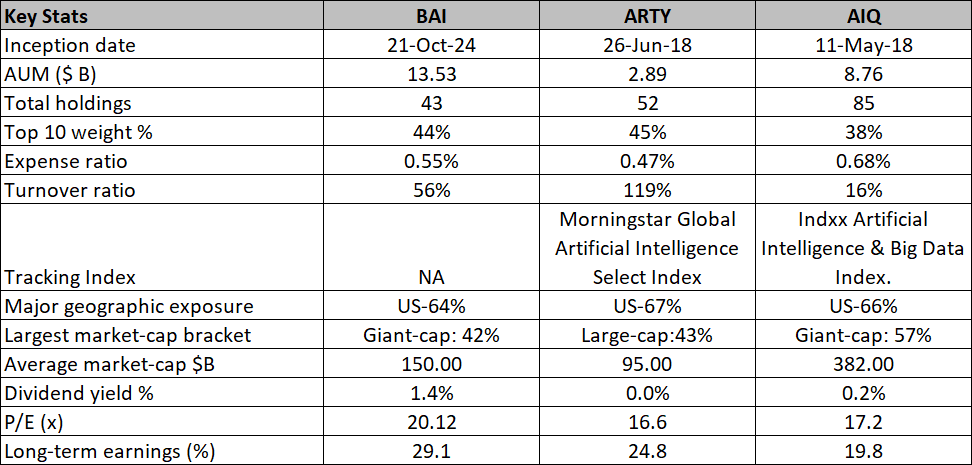
As far as other artificial intelligence & tech ETF peers are concerned, here are two passively managed alternatives (one from iShares and the other from a thematic ETF firm, Global X) that both made their debut in 2018, 6 years before BAI: The Global X Artificial Intelligence & Technology ETF (AIQ) and the iShares Future AI & Tech ETF (ARTY).
AIQ passively tracks an index called the Indxx Artificial Intelligence & Big Data Index, and ARTY tracks the Morningstar Global Artificial Intelligence Select Index. Note that while both these products have been around for far longer than BAI, they haven’t quite managed to attract the same cadence of AUM, which speaks to BAI’s innate popularity.
AIQ, which is the priciest out of the lot (from an expense ratio perspective), is meant for those who want much broader coverage (double the stocks of BAI) and relative stability of holdings (annual churn of just 16%). It is also meant for those who want strong giant-cap exposure (also reiterated by the average market cap). Note, however, that its holdings offer the weakest earnings growth potential.
ARTY, which is the cheaper one of the two (both from an expense ratio perspective as well as valuations), is also the only product that does not pay any distributions. Despite being priced at cheaper valuations, it also offers better earnings growth potential than AIQ. ARTY would appeal more to those who want reduced exposure to giant caps and prefer the next market-cap bracket-large-caps.
Peer comparison (Seeking Alpha, Morningstar)
Summary
BAI offers actively managed coverage of a US-centric but global portfolio of stocks that are set to profit from the technological revolution and the proliferation of AI. BAI, which would appeal to GARP-style investors, also comes across as a highly leveraged bet on the S&P 500.
This article answers three main questions about BAI:
- What are the key features of BAI’s portfolio?
- What type of investor is BAI suitable for, and what are the risks associated with it?
- What are the alternatives to BAI?
Editor’s note: This article is intended to provide a general overview of the ETF for educational purposes only and, unlike other articles on Seeking Alpha, does not offer an investment opinion about the ETF.